

Gold is traditionally thought of as a haven asset — a safe port in a storm. But that hasn’t stopped it from rising to a near nine-year high, and within striking distance of its record, even as equities and other assets traditionally viewed as risky remain buoyant as they rebound from the pandemic-inspired selloff suffered earlier this year.
Chalk it up, in part, to opportunity costs. Efforts by global central banks to push down interest rates, which have fallen into negative territory in real, or inflation-adjusted terms, in the U.S. and are outright negative in many parts of the world, mean that investors who hold gold aren’t missing out on the yield they would earn from holding bonds in more usual circumstances.
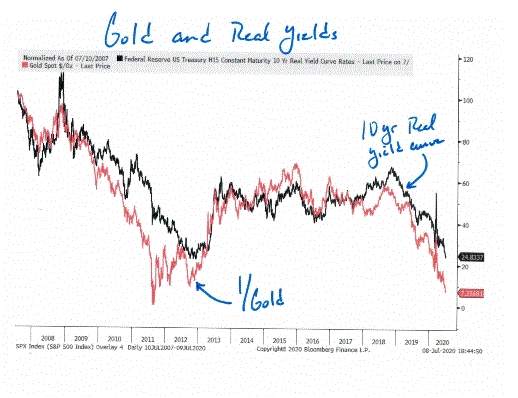
“As real yields turn negative, opportunity costs for holding non-yielding assets essentially vanish, particularly when viewed through the historical lens of fiat currencies and their purchasing power,” wrote Jeff deGraaf, chairman of Renaissance Macro Research, in a Thursday note.
“This provides a continued tailwind for gold,” he said referring to the chart below, which shows the gold price inverted versus the real Treasury yield curve:
RENAISSANCE MACRO RESEARCH
August gold GC00, 0.26% GCQ20, 0.26% fell $16.80, or 0.9%, to settle at $1,803.80 an ounce, a day after the most-active contract rose 0.6% to settle at $1,820.60, the highest since Sept. 14, 2011, according to FactSet data. The weaker tone was accompanied by losses for stocks, with the S&P 500 SPX, -0.56% down 1%.
Gold remains up 0.8% for the week and more than 18% in the year to date, based on the most actively traded contract, according to FactSet.
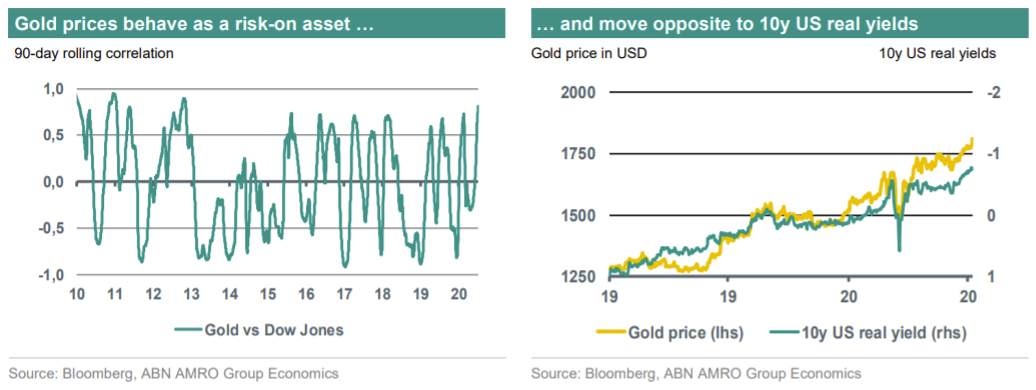
Here’s another look from Georgette Boele, precious-metal strategist at ABN Amro, in a Thursday note. As the chart on the left shows, gold is moving increasingly in lockstep with stocks, as measured by the Dow Jones Industrial Average DJIA, -1.38% , behaving more as a “risk-on” asset — a move aided by the fall in real yields, as reflected by the right-hand chart:
ABN AMRO
“Firstly, central bank policy is a strong driver behind higher gold prices. Not only are official rates close to zero in a large number of countries, they will unlikely go up in our forecast horizon,” Boele wrote.
Most central banks have announced quantitative easing, with the Federal Reserve embarking on unlimited QE and the Bank of Japan and the European Central Bank also implementing large programs. “This sounds like music to the ears of gold bugs as money floods into the market and currencies begin to decline,” she said.
In June, gold-backed ETFs recorded their seventh consecutive month of global positive flows, adding 104 metric tons, which is equivalent to $5.6 billion, or 2.7% of assets under management, the World Gold Council reported on Tuesday. For the first half of the year, global net inflows reached $39.5 billion, surpassing the previous annual inflow record from 2016. #Goldboom##economicindex##CoronavirusWave2.0#
Reprinted from Marketwatch, the copyright all reserved by the original author.
風險提示:本文所述僅代表作者個人觀點,不代表 Followme 的官方立場。Followme 不對內容的準確性、完整性或可靠性作出任何保證,對於基於該內容所採取的任何行為,不承擔任何責任,除非另有書面明確說明。

暫無評論,立馬搶沙發