

Trade is not nuclear science, but neither is it a simple process in which everyone can easily participate. There is a long way to go to understand the needs of traders and the type of tools they actually use in order for a trader to successfully participate in the trading process. Five are the fundamental tools a trader needs in order to participate successfully and systematically upgrade his skills in trading:
Selection of financial instruments
There are dozens of models that a trader uses in trading. Depending on the market conditions and the estimates that they make, traders select simple or complex models to take advantage of the market movements.
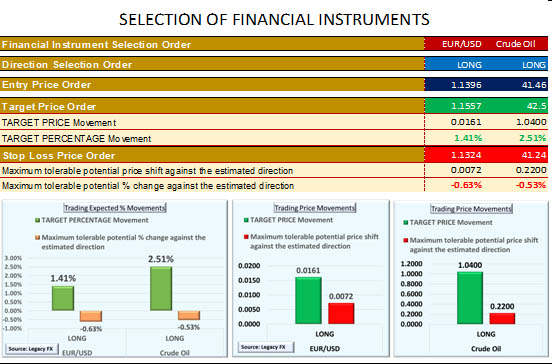
Whether it is the models that make a profit when there is a trend in the market or the models that make a profit from the horizontal movement of the market, the crucial issue is that all these models in each case must clearly define the following three values: the entry price, target price and stop-loss price as a trader select to trade a financial instrument.
No financial instrument should be selected if these prices cannot be accurately determined by the model.Instead, each financial instrument (commodity, currency, index, or stock) can be selected for trading if the above prices can be set.
For example, a trader may take a long position for example in the following financial instruments: EUR / USD and Crude Oil, provided that entry prices, target prices and Stop loss prices can be set, as follows:
Why are these prices important?
Because they are used in the calculation of the optimal size and the calculation of the profitability of a trade.
Risk limitation
The risk limitation of trading positions is defined as the percentage of maximum acceptable potential loss with respect to the total funds intended for trade.
Suppose an investor has 15,000 capitalfor trading in CFD Market.

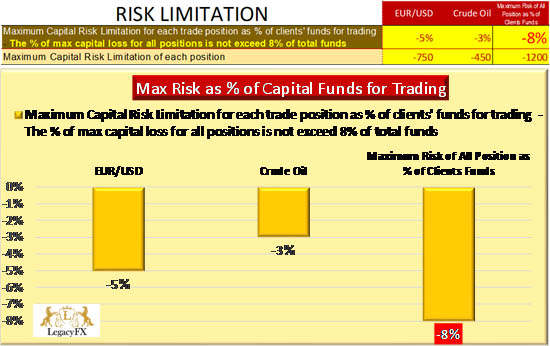
The risk limitation for all investment or trading positions must not exceed 8% of the total funds for trading. The limit of 8% has not been determined by chance. In fact, it has been found that for most traders, 8% of a potential loss on total capital funds for trading, is the greatest limit of loss that if happens a trader can tolerate and manage it in a rational way.
Suppose a trader holds the two positions as shown in the exampleabove.As the maximum loss of all positions held by a trader cannot exceed -8%, we assume that the trader sets for the pair of EUR/USD a maximum loss in terms of total funds -5% and for the Crude Oil maximum loss in terms of total funds -3%. In terms of capital for trading that represents total loss of 15,000*8%=1,200.
Optimal size
Once tradersare able to set entry and stop-loss rates, and since they can set the risk limitation for each position, they are also able to set the optimal size for each trading or investment position.
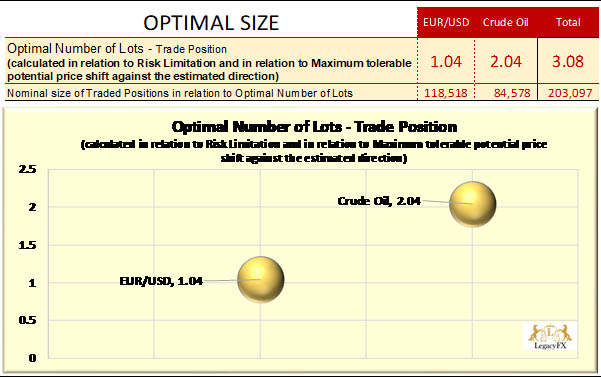
The Optimal Number of Lots, Contracts or Shares for a Trade or investment Position is calculated by dividing, the Maximum tolerable potential price shift of a financial instrument (entry price minus stop loss price), with the maximum potential capital loss -Risk Limitation- set for that financial instrument.

Thus, based on the previous example and making the appropriate calculations, the following results are obtained where the number of lots and the nominal value of the positions in relation to the optimal number of lots are:
Profitability of trade
Based on the optimal size for each trading or investment position can be calculated the potential Profit and the Maxim Capital Loss for each trade position.
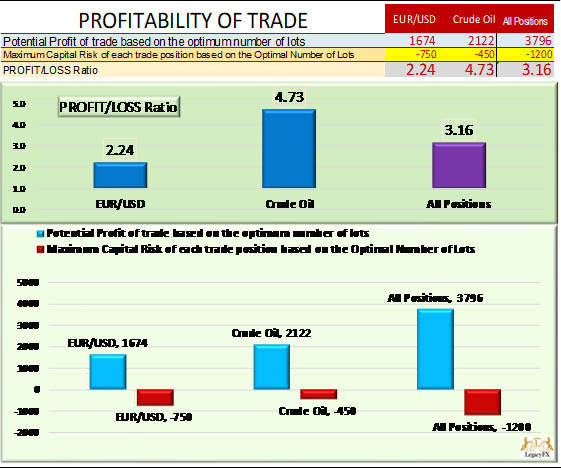
By dividing Potential Profit with Maxim Capital Loss for a trade position we get Profit/Loss Ratio:

A trade position is assumed as profitable when the Profit/Loss ratio is much higher than 1. The higher it is, the more profitable the trading position is judged.
Regarding the previous example, the profitability with the profit and loss ratio is calculated as follows:
Margin requirements
The trading positions have a nominal size calculated in relation to the characteristics of the financial instrument and the optimal number of lots.
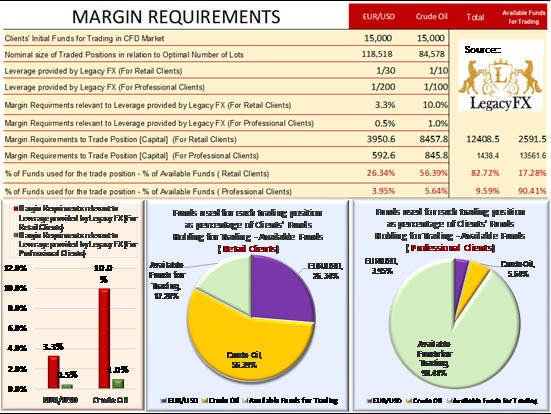
A trader in the CFD market uses only a certain percentage of capital from his funds, compared to the nominal size of the financial instrument, to maintain a trading position on the optimal number of lots.
The Margin requirements for each investment or trading position depends on the characteristics of the financial instruments and the leverage provided by a trading platform.
Professional Clients need much lower margin requirements from retail customers, which means that they always have more available funds. Thus, they are in a better position as they get the trading positions they need while diversifying their portfolios making them more efficient.
In the table below you can see the margin requirements and how they are distributed comparatively between the retail and professional clients.
Once a trader understands the above issues, he can significantly improve his trading capacity in all markets and in all financial instruments.
In other words, the main questions on which traders need to address are:
-
What do they really need so that they can be able to SELECT FINANCIAL INSTRUMENTS?
-
How do they LIMIT their exposure to RISK to a certain level?
-
How do they calculate the OPTIMUM POSITION to be taken when trade in a financial instrument?
-
How do they evaluate if a trade can be PROFITABLE?
-
How capital MARGINS for each trade are calculated?
The answers are given in this article. By having understood the value of these answers and having the appropriate tools to address them, a trader will be able to really upgrade his trading skills.
Reprinted from fxstreet , the copyrights all reserved by the original author.
風險提示:本文所述僅代表作者個人觀點,不代表 Followme 的官方立場。Followme 不對內容的準確性、完整性或可靠性作出任何保證,對於基於該內容所採取的任何行為,不承擔任何責任,除非另有書面明確說明。

暫無評論,立馬搶沙發