


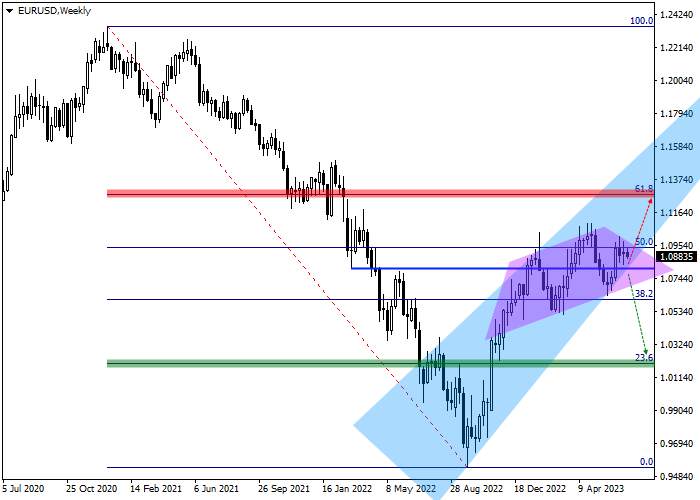
We present a medium-term investment review of the EUR/USD pair.
The situation in the global currency market is developing in favor of the growth of dollar assets, and after the execution of the global corrective scenario by the EUR/USD pair, the downward scenario becomes relevant again. The fundamental background is developing in such a way that the positions of the euro look less preferable against a fairly stable US currency.
Although the situation in the EU economy has recently been improving, its main indicators remain below stability levels: for example, the manufacturing PMI in Germany in June amounted to 41.0 points compared to 43.2 points a month earlier, and this is the lowest since June 2020, when the main stage of the COVID-19 epidemic began in the EU. The service PMI in June reached 54.1 points from 57.2 points earlier, which is also the lowest since the summer of 2020. The negative dynamics of the leading economy of the region were also reflected in the general indicators: the manufacturing PMI in the EU in June amounted to 43.6 points, less than 44.8 points earlier, and the service PMI dropped to 52.4 points from 55.1 points earlier, which is also an anti-record of the last three years.
Another problem for the EU is inflation: although the consumer price index fell to 5.5% in June from 6.1% in May, it is well above the target range with an upper limit of 2.0% of the European Central Bank (ECB). Moreover, the core index rose from 5.3% to 5.4% in June, despite constantly rising interest rates, which puts significant pressure on the economy. According to the latest data, the EU Q1 gross domestic product (GDP) was –0.1% and a continuation of the negative dynamics in the second quarter will mean the onset of a full-fledged recession.
The quotes of the American currency are relatively stable and have been holding above 102.000 in the USD Index for a long time. The US Federal Reserve, as expected, left the interest rate unchanged at 5.25% to assess economic performance but a week later, during a speech by the head of the regulator, Jerome Powell, there were words that a return of the “hawkish” rhetoric was possible at subsequent meetings, after which, according to the Chicago Mercantile Exchange (CME Group), for more than a week the probability of an increase of 25 basis points at the July meeting is estimated at over 76.0%. Thus, there were practically no changes in the US monetary policy, and the June pause in its tightening passed almost unnoticed.
Also to the underlying fundamental factors, the continuation of the negative dynamics is signaled by the readings of technical indicators: on the global chart, the price is growing but after an unsuccessful attempt to consolidate above the Fibonacci 50.0% intermediate correction level at 1.0960, the instrument is preparing for a downward reversal.
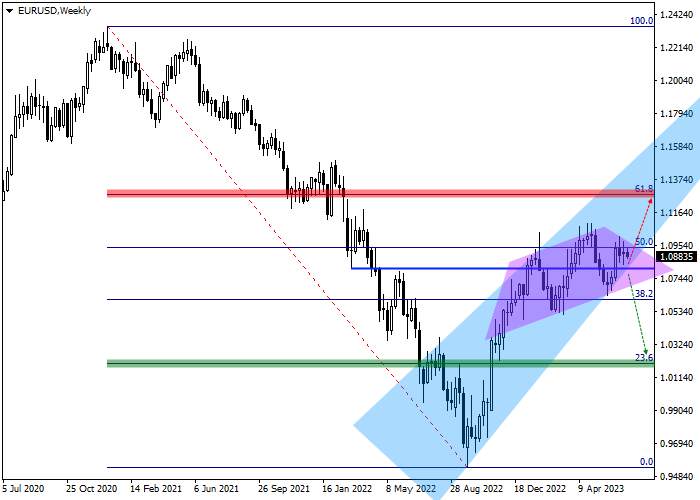
At the moment, the outlines of the Head and shoulders reversal pattern are visible, the implementation of which will lead to a decrease in quotations and their return to the initial correction level of 23.6% Fibonacci around 1.0200.
Let’s consider the key levels on the daily chart.
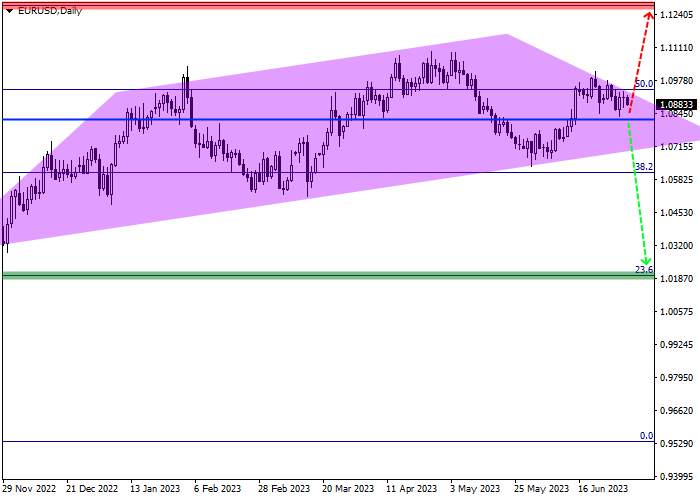
As you can see on the chart, this week, the price is forming the second Shoulder of the pattern, and after reaching the intermediate correction level of 50.0% Fibonacci, it is possible to reverse and decrease to the Neckline around the basic correction level of 38.2% Fibonacci at the level 1.0610. Around the full Fibonacci 61.8% correction at 1.1275, there is a sell signal cancellation zone, if it is reached, it is better to liquidate short positions. Around the initial correction level of 23.6% Fibonacci around 1.0200, there is the target zone, after reaching which, it is better to take profit on open transactions.
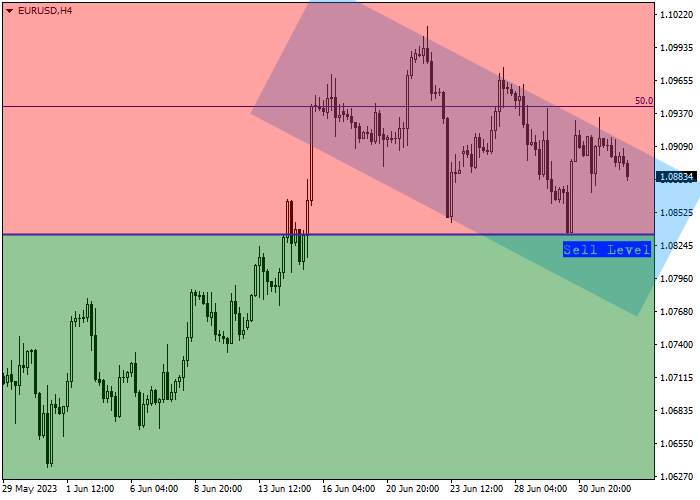
The entry level for sell positions is at 1.0835, which coincides with Monday’s lows, and if it is broken, it is better to implement the positions.
Given the average daily volatility of the trading instrument over the past month, which is 43.6 points, the movement to the target zone of 1.0200 may take approximately 45 trading sessions, but with an increase in volatility in the EUR/USD pair, the time may reduce to 37 days.
風險提示:本文所述僅代表作者個人觀點,不代表 Followme 的官方立場。Followme 不對內容的準確性、完整性或可靠性作出任何保證,對於基於該內容所採取的任何行為,不承擔任何責任,除非另有書面明確說明。

暫無評論,立馬搶沙發