


As we said earlier, in order for someone to invest in a particular stock market, one would need the local currency in order to purchase stocks.
You can imagine the effect that stock markets like the DAX (that’s the German stock market), have on currencies.
In theory, whenever the DAX rises, we can probably expect the euro to rise as well, as investors need to get a hand on some euros.

While the correlation is imperfect, statistics show that it still holds pretty accurately.
We here did a little research of our own and found out that EUR/JPY seems to be highly correlated with stock markets across the globe.
You should know that the yen, along with the U.S. dollar, is considered to be safe havens amongst the major currencies.
Whenever confidence in the global economy is down and traders are fearful, we typically see traders take their money out of the stock markets, which leads to a drop in the values of the DAX and S&P500.
With money flowing out of these markets, we usually see EUR/JPY fall as traders run for cover.
On the flip side, when the sun is bright and risk appetite is rampant, investors pour their money into stock markets, which in turn leads to a rise in the EUR/JPY.
Take a look at the charts below to see the correlation between the EUR/JPY and the DAX and S&P500.
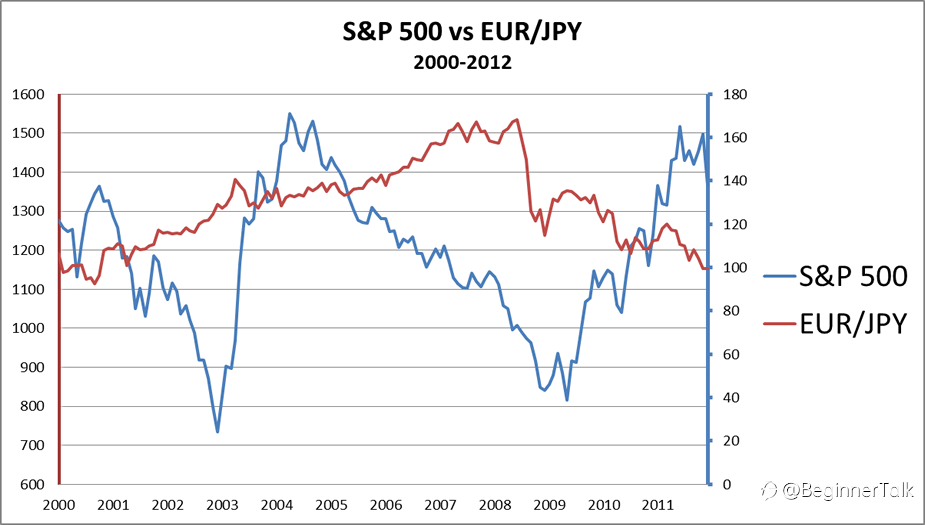
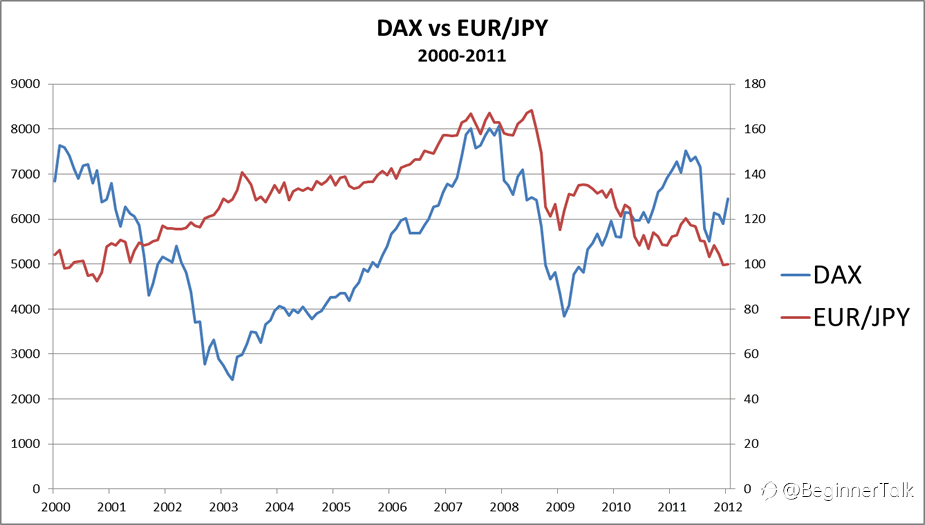
The correlation seems to have held well this past decade, as EUR/JPY and both indexes rose steadily together, until 2008 when we were hit with the Grear Financial Crisis (GFC).
In late 2007, EUR/JPY had hit its peak, and so did the stock indexes.
Reprinted from Babypips, the copyright all reserved by the original author.
風險提示:本文所述僅代表作者個人觀點,不代表 Followme 的官方立場。Followme 不對內容的準確性、完整性或可靠性作出任何保證,對於基於該內容所採取的任何行為,不承擔任何責任,除非另有書面明確說明。

載入失敗()