


| Scenario | |
|---|---|
| Timeframe | Intraday |
| Recommendation | SELL STOP |
| Entry Point | 0.6665 |
| Take Profit | 0.6622 |
| Stop Loss | 0.6690 |
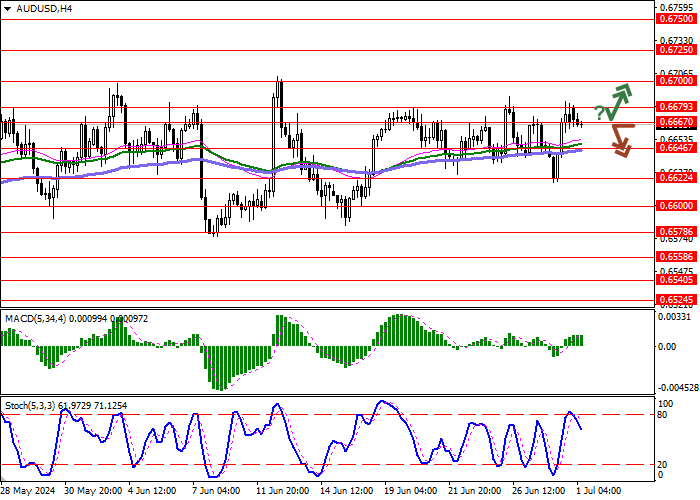
| Key Levels | 0.6600, 0.6622, 0.6646, 0.6667, 0.6679, 0.6700, 0.6725, 0.6750 |
| Alternative scenario | |
|---|---|
| Recommendation | BUY STOP |
| Entry Point | 0.6680 |
| Take Profit | 0.6725 |
| Stop Loss | 0.6655 |
| Key Levels | 0.6600, 0.6622, 0.6646, 0.6667, 0.6679, 0.6700, 0.6725, 0.6750 |
Current trend
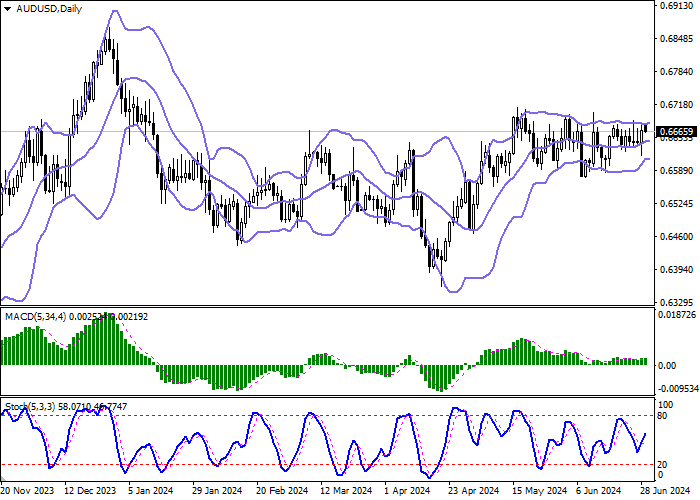
The AUD/USD pair is showing a fairly active decline, retreating from the local highs of June 26. The instrument is testing 0.6665 for a breakdown, while trading participants evaluate incoming macroeconomic statistics from Australia and China. The Australian Manufacturing PMI fell from 47.5 points to 47.2 points in June with neutral forecasts, and the ANZ Job Advertisements in June lost 2.2% after –1.9% in the previous month. In addition, in May, the weighted average Consumer Price Index adjusted from 3.6% to 4.0%, raising fears among experts of a new interest rate increase in August. These data supported the national currency, but further positive dynamics were hampered by comments from Deputy Governor of the Reserve Bank of Australia (RBA) Andrew Hauser, who said that it would be a serious mistake to make decisions based on one inflation report.
Meanwhile, data from China were mixed: the Caixin Manufacturing PMI in June showed a slight increase from 51.7 points to 51.8 points, while analysts expected 51.2 points, but the Non-Manufacturing PMI fell from 51.1 points to 50.5 points with preliminary estimates of 51.0 points, and the NBS Manufacturing PMI remained at the same level of 49.5 points.
The instrument continues to receive some support from expectations regarding the RBA's further monetary policy: last week, investors drew attention to the unexpectedly strong increase in inflation in Australia, which could lead to new increases in borrowing costs from the regulator. In May, the country's Consumer Price Index accelerated from 3.6% to 4.0%, against the expected 3.8%. On Wednesday, the market will receive data on business activity from the Australian Industry Group (AiG) and the Commonwealth Bank, inflation statistics from TD Securities, as well as May statistics on retail sales. In turn, on Friday in the United States, the focus will be on June labor market statistics: forecasts suggest a decrease in Nonfarm Payrolls from 272.0 thousand to 180.0 thousand.
Support and resistance
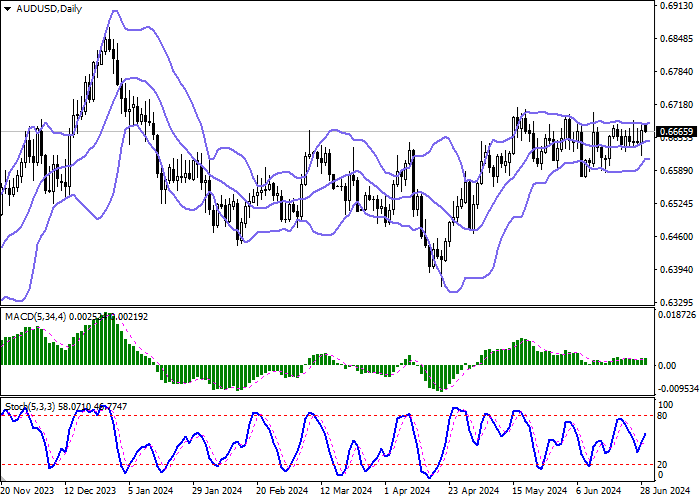
In the D1 chart, Bollinger Bands are reversing horizontally. The price range expands from above, freeing a path to new local highs for the "bulls". MACD is growing preserving a weak buy signal (located above the signal line). Stochastic shows similar dynamics but is rapidly approaching its highs, which reflects risks of the overbought Australian dollar in the ultra-short term.
Resistance levels: 0.6679, 0.6700, 0.6725, 0.6750.
Support levels: 0.6667, 0.6646, 0.6622, 0.6600.
Trading tips
Short positions may be opened after a breakdown of 0.6667 with the target at 0.6622. Stop-loss — 0.6690. Implementation time: 1-2 days.
A rebound from 0.6667 as from support followed by a breakout of 0.6679 may become a signal for opening new long positions with the target at 0.6725. Stop-loss — 0.6655.
風險提示:本文所述僅代表作者個人觀點,不代表 Followme 的官方立場。Followme 不對內容的準確性、完整性或可靠性作出任何保證,對於基於該內容所採取的任何行為,不承擔任何責任,除非另有書面明確說明。

暫無評論,立馬搶沙發