
| Scenario | |
|---|---|
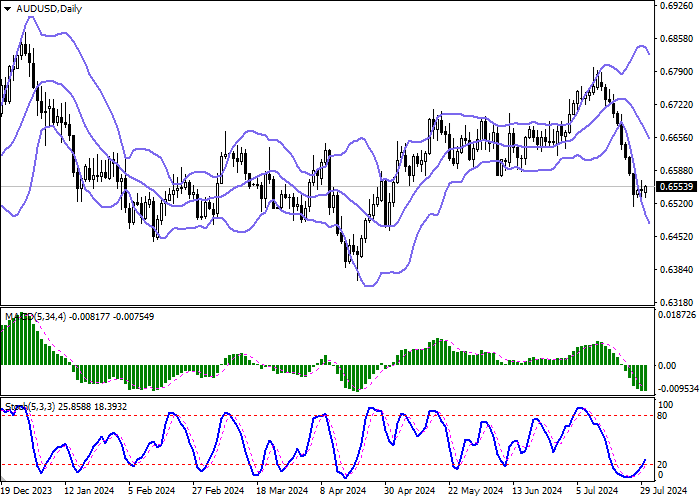
| Time interval | Intraday |
| Recommendation | BUY STOP |
| Entry point | 0.6570 |
| Take Profit | 0.6622 |
| Stop Loss | 0.6540 |
| Key levels | 0.6480, 0.6500, 0.6523, 0.6540, 0.6568, 0.6600, 0.6622, 0.6646 |
| Alternative scenario | |
|---|---|
| Recommendation | SELL STOP |
| Entry point | 0.6540 |
| Take Profit | 0.6480 |
| Stop Loss | 0.6568 |
| Key levels | 0.6480, 0.6500, 0.6523, 0.6540, 0.6568, 0.6600, 0.6622, 0.6646 |
The current dynamics
The AUD/USD pair is showing moderate growth, developing an uncertain uptrend in the ultra-short term and retreating from local lows in early May: the instrument is testing the 0.6555 level for a breakout upwards, while stable positive dynamics are hampered by macroeconomic statistics from Australia. Thus, the number of building permits issued in June decreased by 6.5%, after increasing by 5.7% a month earlier, although analysts expected -3.0% and the annual figure increased from -8.5% to -3.7%.
Tomorrow, inflation data will be released in Australia: the consumer price index is expected to adjust from 3.6% to 3.8% in annual terms and remain at 1.0% in quarterly terms, while the weighted average is likely to remain at 4.0% and the quarterly figure will decline from 1.0% to 0.9%, which confirms limited progress in containing prices. The Reserve Bank of Australia (RBA) has adjusted borrowing costs by fewer basis points than other central banks in an attempt to support employment growth and is concerned about the ability of households with higher debt to cope with a difficult economic situation, so market experts are confident that inflation will not be able to reach the target levels of 2.0-3.0% by the end of next year, which will require a subsequent increase in the reference rate, raising the risk of recession. In addition, tomorrow, investors will pay attention to June statistics on the dynamics of retail sales: experts expect the index to decrease from 0.6% to 0.1%.
In turn, on Wednesday, the US will release a report by the Automatic Data Processing (ADP) company on private sector employment, and the results of the US Fed meeting on the interest rate will be announced. Most experts are confident that officials will leave the interest rate at 5.50%, but will suggest a transition to "peaceful" rhetoric in September, since the conditions for easing monetary policy have now developed in the national economy: pressure on prices is weakening, business activity is slowing down, and the labor market is showing signs of cooling.
Support and resistance levels
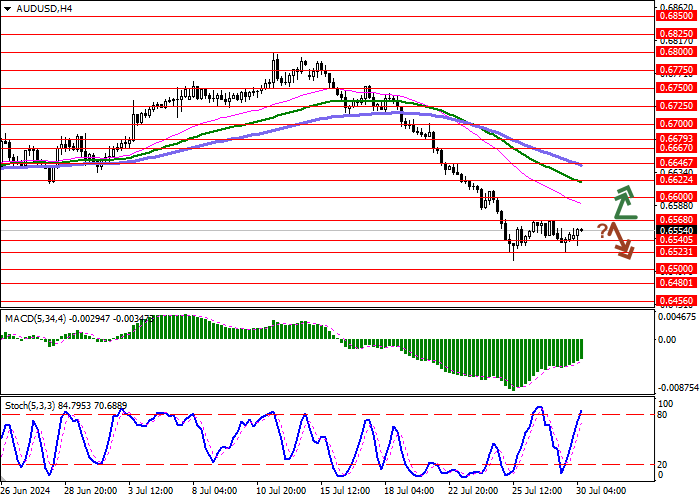
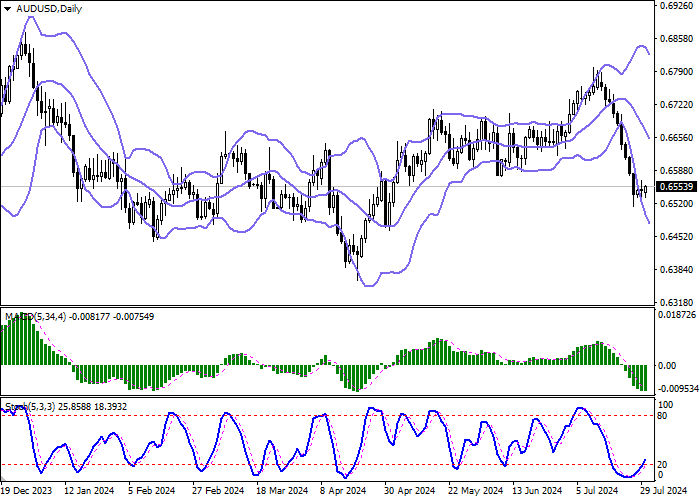
On the daily chart, the Bollinger Bands indicator lines are showing a steady decline: the price range is widening and paving the way for bears to new local lows. The MACD is falling and maintains a firm sell signal (the histogram is below the signal line). The Stochastic, reacting to the emergence of uncertain growth, is trying to reverse upwards, retreating from lows that signal the risks of undervaluation of the Australian dollar in the ultra-short term.
Resistance levels are: 0.6568, 0.6600, 0.6622, 0.6646.
Support levels are: 0.6540, 0.6523, 0.6500, 0.6480.
Trading scenarios
Long positions may be opened after the 0.6568 level is broken upwards with the target at 0.6622. Place Stop Loss order at 0.6540. The execution period is: 1-2 days.
The rebound from the 0.6568 level as a resistance with a successive break of the 0.6540 level downwards could become a signal to open new short positions with a target at 0.6480. Place Stop Loss order at 0.6568.
風險提示:本文所述僅代表作者個人觀點,不代表 Followme 的官方立場。Followme 不對內容的準確性、完整性或可靠性作出任何保證,對於基於該內容所採取的任何行為,不承擔任何責任,除非另有書面明確說明。
 暫無留言。 來發表第一則觀點吧。