



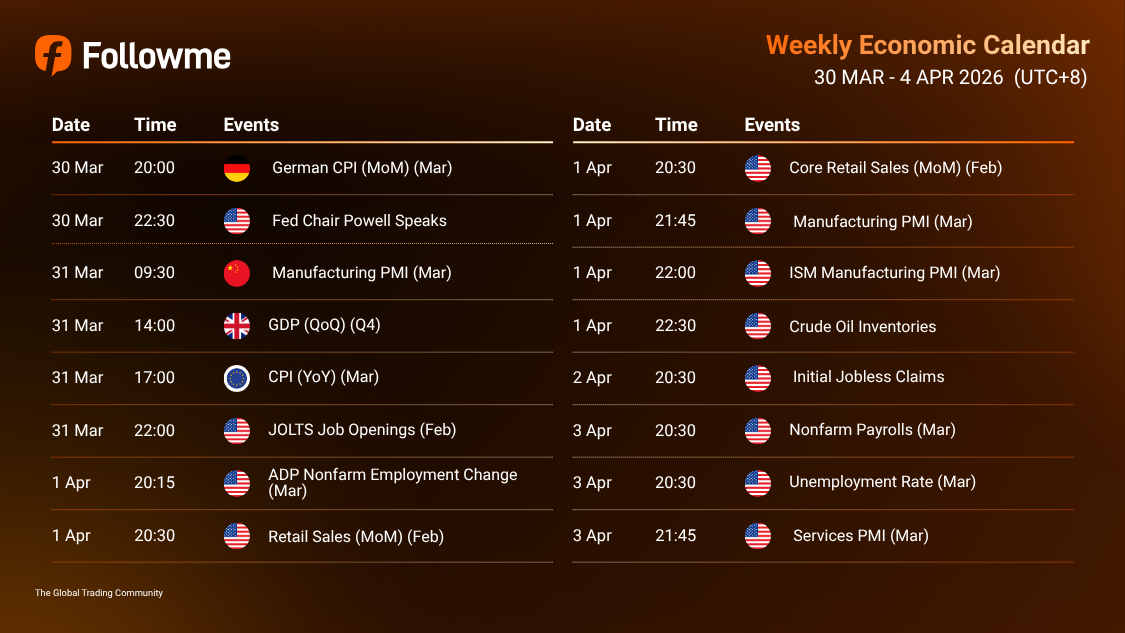
Weekly Economic Calendar: Week of March 30 - 04 April, 2026 (GMT+8)
| Key highlights: |
🇺🇸 30 Mar, 22:30 – Fed Chair Powell Speaks
🇨🇳 31 Mar, 09:30 – Manufacturing PMI (Mar)
🇬🇧 31 Mar, 14:00 – GDP (QoQ) (Q4)
🇪🇺 31 Mar, 17:00 – CPI (YoY) (Mar)
🇺🇸 31 Mar, 22:00 – JOLTS Job Openings (Feb)
🇺🇸 1 Apr, 20:15 – ADP Nonfarm Employment Change (Mar)
🇺🇸 1 Apr, 20:30 – Retail Sales (MoM) (Feb)
🇺🇸 1 Apr, 20:30 – Core Retail Sales (MoM) (Feb)
🇺🇸 1 Apr, 21:45 – Manufacturing PMI (Mar)
🇺🇸 1 Apr, 22:00 – ISM Manufacturing PMI (Mar)
🇺🇸 1 Apr, 22:30 – Crude Oil Inventories
🇺🇸 2 Apr, 20:30 – Initial Jobless Claims
🇺🇸 3 Apr, 20:30 – Nonfarm Payrolls (Mar)
🇺🇸 3 Apr, 20:30 – Unemployment Rate (Mar)
🇺🇸 3 Apr, 21:45 – Services PMI (Mar)
🇪🇺 Germany Inflation Signal on Monday
German CPI (MoM) is the first notable release of the week and can shape early EUR sentiment by influencing expectations around the broader Eurozone inflation path.
🇺🇸 Powell Speech Risk on Monday Night
Fed Chair Powell Speaks is important because even without a formal policy decision, markets often react quickly to any shift in tone on inflation, labor conditions, or the future path of rates. If Powell sounds firm and cautious on inflation, the dollar may stay supported.
🇨🇳 China Growth Check on Tuesday Morning
Manufacturing PMI matters because it gives the market an early read on Chinese industrial momentum and broader regional risk sentiment. A move above expectations can support commodity-linked sentiment and improve confidence in Asian growth.
🇬🇧 UK Growth Signal on Tuesday Afternoon
UK GDP (QoQ) is important for GBP because it reflects the near-term pace of economic activity. A firmer growth number can support the pound by suggesting better domestic resilience, while a soft result may reinforce concerns around weak momentum and limit upside in GBP pairs.
🇪🇺 Eurozone Inflation Focus on Tuesday Evening
CPI (YoY) is the key inflation release for EUR this week. If inflation comes in hotter than expected, traders may reduce expectations for a softer policy path, which can support the euro. A weaker number would likely encourage a more dovish interpretation and pressure EUR.
🇺🇸 U.S. Labor Demand Signal on Tuesday Night
JOLTS Job Openings gives traders another look at labor-market tightness in the United States. A stronger reading can support the view that employment demand remains resilient, which may keep Fed expectations firm and support the dollar. A softer number may suggest gradual cooling in labor conditions.
🇺🇸 Major U.S. Data Cluster on Wednesday
Wednesday is the most data-heavy session of the week before payrolls. ADP Nonfarm Employment Change offers an early private-sector labor signal, while Retail Sales and Core Retail Sales provide a direct read on consumer demand. Manufacturing PMI and ISM Manufacturing PMI then help confirm whether business activity remains stable or is losing momentum. Together, these releases can strongly influence expectations for both growth and Fed policy direction.
🇺🇸 Energy and Inflation Link on Wednesday Night
Crude Oil Inventories can matter through the inflation channel. A large draw may support oil prices and reinforce inflation concerns, while a large build may weigh on oil and slightly reduce near-term inflation pressure.
🇺🇸 U.S. Labor Checkpoint on Thursday
Initial Jobless Claims provides a fresh weekly snapshot of labor-market conditions ahead of Friday’s payroll report. A lower claims number can reinforce the idea that layoffs remain contained, which supports the dollar.
🇺🇸 Main USD Event Window on Friday
Nonfarm Payrolls and the Unemployment Rate are the core releases of the week for USD traders. These two indicators can quickly reset market expectations around the health of the labor market, the path of U.S. rates, and overall dollar direction. If payroll growth is strong and unemployment remains contained, the market may interpret the U.S. economy as still resilient.
🇺🇸 Services Sector Follow-Through on Friday Night
Services PMI helps confirm whether the largest part of the U.S. economy is still expanding steadily after the labor-market data. A stronger reading can reinforce a positive post-NFP dollar reaction, while a weak number may limit USD follow-through or trigger reversals if the earlier jobs data was only moderately supportive.
This is a U.S.-heavy macro week with the biggest pricing risk concentrated from Wednesday through Friday. Early cross-market signals from Germany, China, the UK, and the Eurozone may shape positioning first, but the broader market focus is likely to shift toward the dollar once the ADP, retail, manufacturing, claims, and payrolls sequence begins. Friday’s labor data is the clearest potential catalyst for a decisive move in USD, yields, gold, and broader risk sentiment.
🟢 Bullish USD Scenario – Stronger Dollar Case
-
Powell sounds firm and keeps attention on inflation or the need for policy discipline
-
JOLTS Job Openings shows labor demand remains solid
-
ADP comes in stronger than expected, reinforcing labor-market resilience
-
Retail Sales and Core Retail Sales improve, supporting the U.S. consumer narrative
-
Manufacturing PMI and ISM Manufacturing PMI point to stable or improving business activity
-
Initial Jobless Claims stays low, showing layoffs remain contained
-
Nonfarm Payrolls beats expectations and the Unemployment Rate stays steady or falls
-
Services PMI holds firm, confirming broader economic resilience
🔴 Bearish USD Scenario – Weaker Dollar Case
-
Powell sounds more cautious on growth or less supportive of a restrictive stance
-
JOLTS softens, suggesting labor demand is easing
-
ADP disappoints, weakening confidence ahead of payrolls
-
Retail Sales and Core Retail Sales miss expectations, pointing to softer consumption
-
Manufacturing PMI and ISM Manufacturing PMI show slower activity or fading momentum
-
Initial Jobless Claims rises, signaling labor-market cooling
-
Nonfarm Payrolls underperforms and the Unemployment Rate rises above the prior level
-
Services PMI weakens, adding to the case for softer U.S. growth momentum
🟡 Wild Cards – High Whipsaw Risk
-
Powell’s tone may move the dollar early even before the main U.S. data cluster begins
-
Mixed signals between ADP and Nonfarm Payrolls may create sharp reversals in USD positioning
-
Strong labor data but weak retail or PMI data may produce choppy and inconsistent price action
-
Crude Oil Inventories may affect inflation expectations indirectly through energy prices
-
A strong NFP number paired with a weaker Services PMI may limit clean trend continuation
-
Early-week surprises in German CPI, Eurozone CPI, China PMI, or UK GDP may temporarily distort broader FX sentiment before the market refocuses on U.S. data
Check out full here: Followme Economic Calendar Tool
Follow Followme for the newest market updates




風險提示:本文所述僅代表作者個人觀點,不代表 Followme 的官方立場。Followme 不對內容的準確性、完整性或可靠性作出任何保證,對於基於該內容所採取的任何行為,不承擔任何責任,除非另有書面明確說明。
 暫無留言。 來發表第一則觀點吧。