



MARKET REVIEW FOREX Global Markets
Back to 1986! Yen Just Broke 40 Years of History
Yen crashes through its weakest point in 40 years as Tokyo hesitates.
Followme News Desk | June 30, 2026, Tokyo
Tuesday turned into one of the rawest sessions the yen has seen all year. USD/JPY pushed through 162.00, a level untouched since 1986, and Tokyo's warnings barely registered. Chief Cabinet Secretary Minoru Kihara repeated that officials are always ready to take necessary action on forex, though he avoided naming a specific level, and the pair surged past 162.00 anyway during the Asian session.
Behind the scenes, Finance Minister Satsuki Katayama and US Treasury Secretary Scott Bessent have stayed in direct, ministerial-level contact over the slide. That's a step up from the usual lower-level channel, and it's worth paying attention to, it suggests Tokyo has moved past the warning stage.
The Yen Is Cracking And Tokyo Is Running Out of Road
For weeks, the yen has shrugged off both jawboning and actual intervention. Every fresh warning gets a brief pause, then more selling resumes. For households in Japan, a weaker yen means pricier fuel and groceries, and that's starting to show up as political pressure on a government already under scrutiny over living costs.
The Call That Keeps Getting Watched
The market keeps circling back to the Katayama-Bessent relationship for a reason. The two reportedly held a lengthy call following last week's G7 meeting in France, with Japan and the US reaffirming a shared stance that bold FX action remains possible, even as Katayama avoided commenting on current levels. Japan has historically wanted at least a quiet nod from Washington before stepping into currency markets, given how sensitive the US is about its trading partners managing their currencies. Ministerial-level contact is the kind of detail that's easy to read too much into, but it's hard to ignore entirely.
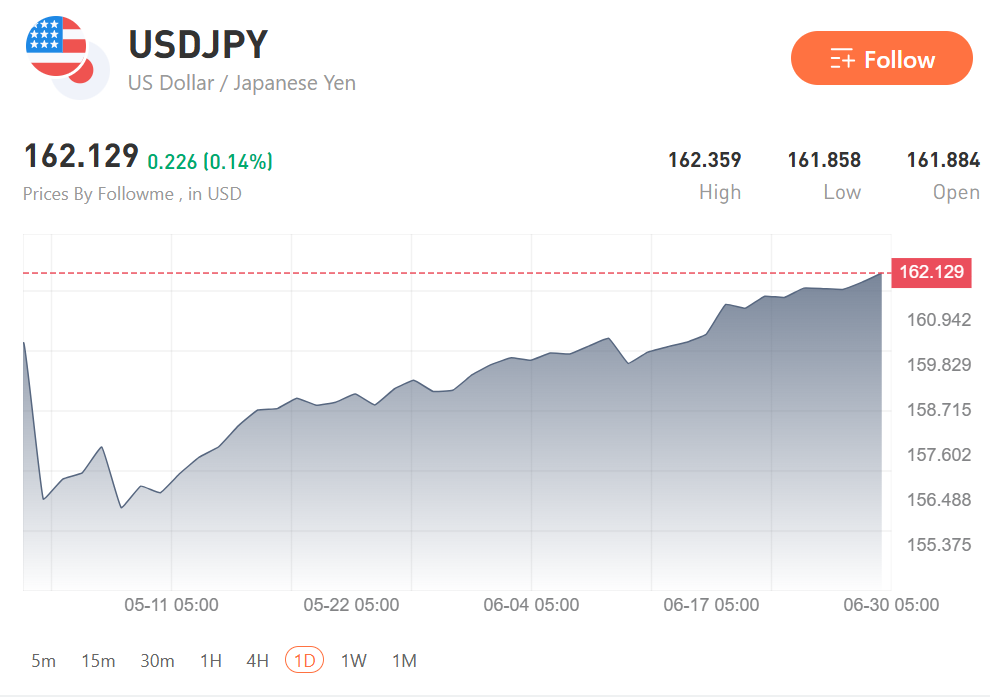
USD/JPY 162.00+ as of Jun 30, 2026 — View Live Chart →
Why Words Alone Aren't Working
The numbers explain why jawboning keeps failing. Japan already spent a record 11.73 trillion yen, or roughly $72.5 billion, defending the yen between late April and late May, and that move provided only limited support, with the currency drifting back toward 40-year lows within a month. The US-Japan rate gap is still wide enough to make the yen-funded carry trade one of the more reliable profit machines around, so every intervention just resets the entry point for traders who come right back in.
That's where the BOJ's inflation debate matters. A former senior BOJ official says the next rate hike could land before December, earlier than consensus, pointing to an underlying inflation gauge that's averaged near 3% over the past four years, well above the bank's 2% target. Headline CPI looks softer mainly because of government subsidies. If the BOJ leans into that internal measure, an earlier hike could close some of the rate gap, though "could" is doing a lot of work there, and the board hasn't signaled it's ready to make that shift yet.
The Line Everyone Is Watching
161.96 was the number traders had circled, crossed it, and the yen hit its weakest point since 1986. The pair has already pushed past 162.00, so that line is gone, and the question now is less "will it break" and more "what does Tokyo do about it."
What Traders Should Watch
USD/JPY - The 161.96 trigger has already given way. Whether Tokyo intervenes directly or just keeps talking is the open question, and past intervention has bought weeks of relief at best, not a reversal.
GBP/JPY - Yen weakness has been dragging this cross higher too, with an ascending triangle pattern putting the year-to-date high in play. It's arguably more exposed to a sudden BOJ-driven yen rebound than USD/JPY itself, since it carries both sides of the rate story.
EUR/JPY - Broad yen weakness rather than dollar strength alone has been doing the work, so this pair is a cleaner read on pure yen sentiment if intervention or a BOJ hike hits.
Nikkei 225 - Japanese exporters have been quietly benefiting from the weak yen, supporting the stock market. A sharp yen rebound from intervention or a hawkish BOJ surprise could flip that tailwind into a headwind fast.
The Bottom Line The yen's real floor probably isn't going to come from Tokyo's intervention fund. It's more likely to come from whether the Bank of Japan actually moves on rates sooner than the market currently expects.
Follow us for daily market insights, analysis, and the tools you need to trade with confidence.
Want to stay ahead of major macro developments that move the Forex market? 👉 Follow Followme and check out the Weekly Economic Calendar
June 30, 2026 | This report is for informational purposes only and does not constitute financial advice. © 2026 Followme News




風險提示:本文所述僅代表作者個人觀點,不代表 Followme 的官方立場。Followme 不對內容的準確性、完整性或可靠性作出任何保證,對於基於該內容所採取的任何行為,不承擔任何責任,除非另有書面明確說明。
 暫無留言。 來發表第一則觀點吧。