

MACRO ECONOMIC CALENDAR
Weekly Economic Calendar: Week of 31 August – 4 September 2026
Followme News Desk | August 31, 2026 | All times GMT+8
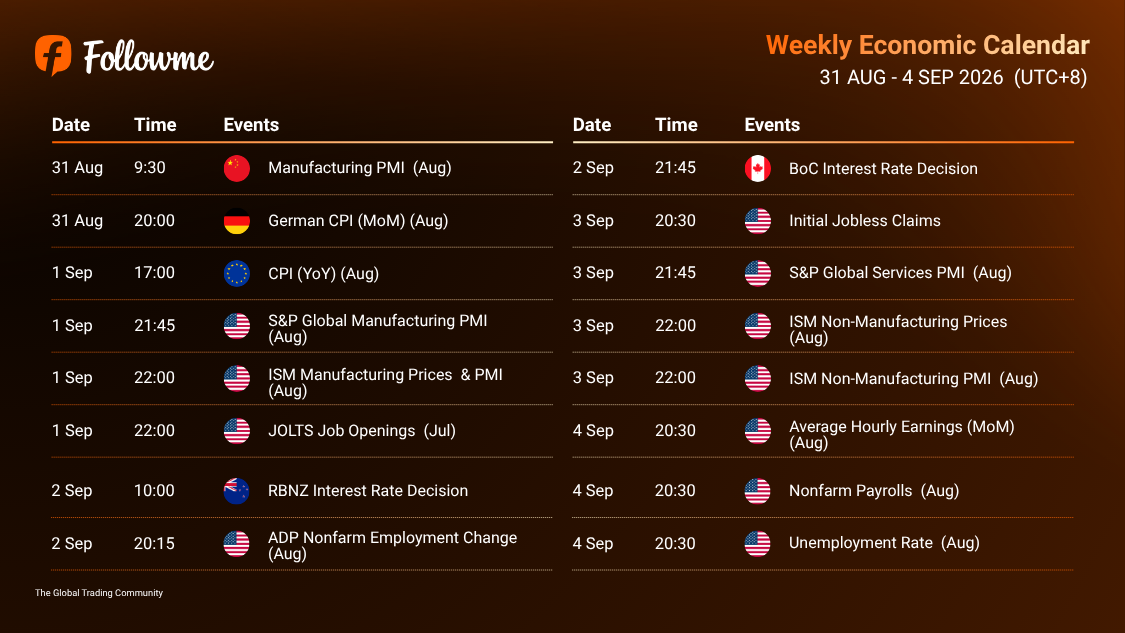
This week’s economic calendar is heavily focused on China Manufacturing PMI, German CPI (MoM), EU CPI (YoY), U.S. S&P Global and ISM Manufacturing PMI, ISM Manufacturing Prices, JOLTS Job Openings, the RBNZ Interest Rate Decision, U.S. ADP Nonfarm Employment Change, the Bank of Canada Interest Rate Decision, U.S. Initial Jobless Claims, S&P Global and ISM Non-Manufacturing PMI, ISM Non-Manufacturing Prices, U.S. Average Hourly Earnings, Nonfarm Payrolls and the Unemployment Rate.
Monday and Tuesday build the global and manufacturing picture. Wednesday packs the RBNZ hike, a critical ADP print and the BoC decision into a single session before Thursday followed with claims and services data.
Nonfarm Payrolls is the standout event and it carries more weight than most. With the forecast at just 85K against a prior reading of 20K, this NFP already implies significant labour market deterioration and everything earlier in the week will be read as a leading signal for whether Friday delivers a shock or a surprise to the upside. ADP on Wednesday is the number to watch most closely before payrolls, and the gap between 68K forecast and 95K prior means this week’s ADP could move markets almost as much as NFP itself.
Key Events This Week
🕐 All times shown are GMT+8
| Date | Time | CCY | Event | Forecast | Previous |
|---|---|---|---|---|---|
| 31/8 | 09:30 | 🇨🇳 CNY | Manufacturing PMI (Aug) | 50.1 | 50.3 |
| 20:00 | 🇩🇪 DEM | German CPI (MoM) (Aug) | 0.80% | -0.30% | |
| 1/9 | 17:00 | 🇪🇺 EUR | CPI (YoY) (Aug) | 2.90% | 2.80% |
| 21:45 | 🇺🇸 USD | S&P Global Manufacturing PMI (Aug) | 54.0 | 53.9 | |
| 22:00 | 🇺🇸 USD | ISM Manufacturing Prices (Aug) | 70.0 | 73.0 | |
| 22:00 | 🇺🇸 USD | ISM Manufacturing PMI (Aug) | 54.0 | 53.3 | |
| 22:00 | 🇺🇸 USD | JOLTS Job Openings (Jul) | 7.440M | 7.537M | |
| 2/9 | 10:00 | 🇳🇿 NZD | RBNZ Interest Rate Decision | 2.50% | 2.25% |
| 20:15 | ⭐ 🇺🇸 USD | ADP Nonfarm Employment Change (Aug) | 68.00K | 95.00K | |
| 21:45 | 🇨🇦 CAD | BoC Interest Rate Decision | 2.25% | 2.25% | |
| 3/9 | 20:30 | 🇺🇸 USD | Initial Jobless Claims | 210.00K | 212.00K |
| 21:45 | 🇺🇸 USD | S&P Global Services PMI (Aug) | 53.9 | 54.6 | |
| 22:00 | 🇺🇸 USD | ISM Non-Manufacturing Prices (Aug) | 65.0 | 67.7 | |
| 22:00 | 🇺🇸 USD | ISM Non-Manufacturing PMI (Aug) | 54.5 | 54.0 | |
| 4/9 | 20:30 | 🇺🇸 USD | Average Hourly Earnings (MoM) (Aug) | 0.30% | 0.30% |
| 20:30 | ⭐ 🇺🇸 USD | Nonfarm Payrolls (Aug) | 85.00K | 20.00K | |
| 20:30 | 🇺🇸 USD | Unemployment Rate (Aug) | 4.20% | 4.20% |
Macro Analysis
🇨🇳 China Manufacturing PMI
China’s Manufacturing PMI for August is forecast at 50.1, a slight easing from 50.3 prior holding at the expansion line but barely. It’s not a number that will move currency markets dramatically, but in a week that builds toward Friday’s NFP, any signal about the health of the world’s second-largest economy matters for broader risk appetite. A reading that stays at or above 50 keeps the global manufacturing narrative mildly constructive. A slip below 50 would signal contraction and could add a risk-off tone to the start of the week that carries into Tuesday’s heavily loaded session.
🇩🇪 German CPI (MoM)
German CPI for August is forecast at 0.80%, a sharp reversal from -0.30% prior. After two consecutive months of negative monthly prints, a move this large in the opposite direction would be notable and would give the ECB meaningful pause before cutting further. If confirmed, it would support EUR heading into Tuesday’s Eurozone CPI reading, as traders would start pricing a more cautious ECB stance. A mistake that keeps the reading closer to flat or negative would accelerate ECB easing expectations and weigh on EUR before the full Eurozone picture even arrives.
🇪🇺 EU CPI (YoY)
Eurozone CPI for August is forecast at 2.90%, ticking up from 2.80% prior. After the German CPI lands Monday, the Eurozone-wide reading on Tuesday will either confirm or contradict what Germany showed. If both come in firm, the ECB’s ability to cut aggressively gets more complicated, which is broadly EUR-positive. A miss on the Eurozone figure, particularly if it drops toward 2.70% or below, would accelerate ECB easing expectations and weigh on the single currency heading into Wednesday’s central bank decisions and the rest of the week’s U.S. data.
🇺🇸 U.S. S&P Global Manufacturing PMI
S&P Global Manufacturing PMI for August is forecast at 54.0, building slightly on 53.9 prior. A reading at or above 54 would suggest U.S. Factory activity continues to expand at a healthy pace even as other parts of the economy soften, which supports USD sentiment heading into the week’s heavier labour data. A miss that pulls the index back toward 53 wouldn’t be alarming in isolation, but, coming in the same session as ISM data and JOLTS, it would add to any broader sense that the economic picture is dimming before Friday’s NFP.
🇺🇸 U.S. ISM Manufacturing PMI and Prices
ISM Manufacturing PMI for August is forecast at 54.0, up from 53.3 prior, while ISM Manufacturing Prices are forecast at 70.0, easing from 73.0. The PMI move higher is constructive, continued expansion above 54 would signal genuine factory momentum. The price decline from 73 to 70 is the most interesting detail: input costs coming down in the manufacturing sector supports the broader disinflation story without undermining the growth picture. If both numbers land close to forecast, it gives the Fed a relatively clean data point growth holding, inflation cooling and USD should remain well supported through Tuesday.
🇺🇸 U.S. JOLTS Job Openings
JOLTS Job Openings for July are forecast at 7.440M, pulling back from 7.537M prior. In a normal week, a move of this size would be noticed but not market-moving. In a week where NFP is the Friday standout, every labour market signal between now and then carries extra weight. A reading close to or above 7.537M would suggest hiring demand is holding up and calming some of the concerns around Friday’s weak payroll forecast. A drop well below 7.440M would raise the stakes for NFP and could start moving USD lower before ADP and the RBNZ even land on Wednesday.
🇳🇿 RBNZ Interest Rate Decision
The RBNZ is expected to hike to 2.50% from 2.25% prior, a meaningful move that confirms the Reserve Bank of New Zealand is still in tightening mode. A hike in line with expectations should support NZD, but what really matters is whether the statement signals more hikes ahead or frames this as potentially near the peak. A hawkish hike with firm forward guidance would lift NZD meaningfully. A hike paired with more cautious language about the outlook would limit the rally and could allow NZD to give back some gains quickly, particularly if ADP on the same day also disappoints.
🇺🇸 U.S. ADP Nonfarm Employment Change
ADP for August is forecast at 68K, a sharp drop from 95K prior and a number that already implies significant labour market slowing well ahead of Friday’s official release. As the first direct employment read of the week, a print near 68K would validate the weak NFP forecast and likely start a USD selloff that carries through the week. A meaningful beat above 95K would flip the script entirely and give USD bulls something to push back with before Friday. The gap between forecast and prior is wide enough that there’s real potential for surprise in either direction, making this one of the more important ADP prints in recent months.
🇨🇦 Bank of Canada Interest Rate Decision
The BoC is expected to hold at 2.25%, unchanged from the prior meeting. A hold is widely priced in, so the rate itself won’t generate much reaction, what traders will be watching is any shift in language around whether the next move is a cut or whether the BoC is comfortable holding for longer. A statement that sounds more dovish than expected would weigh on CAD, particularly if ADP had already delivered a soft number earlier in the same session. A firm, inflation-wary tone could give CAD modest support against a dollar that may already be under pressure from labour data.
🇺🇸 U.S. Initial Jobless Claims
Claims are forecast at 210K, ticking up from 212K prior, a small move in the right direction. Low and stable claims heading into NFP week is the kind of backdrop that keeps the labour market story from deteriorating before the headline data arrives. A reading at or below 210K would provide some reassurance that layoffs aren’t picking up even as new job creation slows. A jump above 215K or higher, on the same day as services data and a day before NFP, would be the worst possible signal before Friday’s payroll release and would amplify any bearish USD positioning.
🇺🇸 U.S. S&P Global Services PMI
S&P Global Services PMI for August is forecast at 53.9, easing from 54.6 prior a pullback but still comfortably in expansion. The services sector has been the backbone of U.S. economic resilience this year, so any deceleration gets attention. A reading close to 53.9 or above would keep the expansion narrative intact heading into NFP. A more meaningful drop toward 52 or below would raise fresh concern about whether services momentum is fading, and combined with weak claims and soft ADP, could create a very bearish USD setup heading into Friday.
🇺🇸 U.S. ISM Non-Manufacturing PMI and Prices
ISM Non-Manufacturing PMI for August is forecast at 54.5, up from 54.0 prior, while Non-Manufacturing Prices are forecast at 65.0, down from 67.7. A PMI that ticks higher, while prices ease is the same constructive combination seen in manufacturing data growth holding up, cost pressures moderating. If both readings come in close to forecast, it would add another layer of support to the soft-landing narrative ahead of Friday’s NFP. A sharp drop in the PMI toward 52 or below would introduce genuine concern about the services sector slowing faster than expected.
🇺🇸 U.S. Nonfarm Payrolls, Average Hourly Earnings and Unemployment Rate
This is the week’s standout release. Nonfarm Payrolls for August are forecast at just 85K, a dramatic drop from 20K prior the kind of number that, if confirmed, would be the weakest monthly jobs print in well over a year. Average Hourly Earnings (MoM) are forecast at 0.30%, flat with the prior reading, and the Unemployment Rate is expected to hold at 4.20%. A payroll print near 85K would almost certainly accelerate rate cut expectations and deliver a meaningful USD selloff heading into the weekend. A surprise beat anything materially above 100K would dramatically change the week’s narrative and send the Dollar sharply higher. The stakes around this NFP are unusually high given how weak the forecast already is.
Speculative Outlook for USD Traders
This is a genuinely loaded week. The early data China PMI, German CPI and EU CPI on Monday and Tuesday sets the global backdrop. Tuesday’s U.S. manufacturing data and JOLTS then give you the first read on how the domestic economy is holding. Wednesday brings the RBNZ hike, a potentially market-moving ADP at 68K and the BoC decision all in one session. Thursday follows with claims and services data. Then Friday delivers what could be the weakest NFP in over a year.
The ADP print on Wednesday is critical. With the NFP forecast already as low as 85K, a soft ADP near 68K would start a USD selloff that accelerates into Friday if claims also disappoint on Thursday. A strong ADP beat would flip the week’s narrative. Suddenly 85K looks like a low-ball estimate and traders start positioning for an NFP surprise. By Thursday evening, the market will have processed enough signals to form a clear view about which way it’s leaning, and Friday’s payroll release either validates or blows that up entirely.
🟢 Bullish USD Scenario — Stronger Dollar Case
- ADP Beats 95K on Wednesday — A private-sector jobs number well above forecast would immediately reduce the credibility of the 85K NFP forecast and push USD higher heading into the back half of the week.
- NFP Surprises Above 100K on Friday — A payroll beat of this magnitude would be the single biggest USD catalyst of the week and would reverse whatever dovish positioning had built up through the earlier data.
- ISM Manufacturing Prices Hold Firm Above 70 — Sticky input costs in the manufacturing sector would complicate the disinflation narrative and give the Fed less urgency to cut.
- JOLTS Holds Near 7.537M — Job openings not falling as much as feared would keep the labour market story intact heading into ADP and NFP.
- German CPI Beats 0.80% — A hotter-than-expected German print would support EUR and reinforce the global inflation-is-sticky narrative that keeps the Fed patient.
- Claims Stay Below 210K Thursday — Contained jobless claims the day before NFP would reduce the downside risk around Friday’s payroll print and keep USD better supported.
🟡 Wild Cards — High Whipsaw Risk
- ADP Beats Then NFP Disappoints — A strong ADP on Wednesday triggers USD buying, then a soft NFP on Friday reverses it all. Anyone who is positioned aggressively mid-week gets caught twice.
- RBNZ Hike with Dovish Statement — A rate move paired with cautious language could confuse NZD traders and create cross-currency moves that ripple into broader risk sentiment on an already busy Wednesday.
- NFP at Exactly 85K — A payroll print bang on the forecast wouldn’t give bulls or bears a clean read. The reaction could be directionless before the wages and unemployment rate numbers determine which way the market settles.
- EU CPI Beats While U.S. ADP Misses — Stronger Eurozone inflation landing on the same day as soft U.S. employment data would push EUR/USD sharply higher and hit USD from two directions simultaneously.
- ISM Services and Manufacturing Both Disappoint — If both PMI readings on Tuesday and Thursday come in the forecast below, the expansion picture starts looking fragile across the whole economy heading into an already weak NFP week.
- BoC Sounds Unexpectedly Hawkish — A firm BoC statement on the same day as a soft ADP print would create sharp CAD/USD moves and add cross-market noise to an already complicated Wednesday session.
🔴 Bearish USD Scenario — Weaker Dollar Case
- NFP Disappoints at or Below 85K — A payroll print this weak would trigger immediate and broad USD selling as rate cut expectations accelerate sharply heading into the weekend.
- Unemployment Rate Ticks to 4.30% or Above — A rise in the jobless rate alongside a soft payroll print would deepen the bearish USD reaction and raise genuine concern about the labour market turning.
- ADP Misses Badly Below 68K — A worse-than-forecast private-sector jobs number on Wednesday sets the tone for a weak NFP and starts the USD selloff days before the headline data even arrives.
- JOLTS Falls Sharply Below 7.440M — A meaningful miss on job openings would signal that hiring demand is deteriorating faster than expected and ratchet up the pressure on USD before the week’s biggest data hits.
- EU CPI Beats alongside the German CPI Beat — Two consecutive upside European inflation surprises in two days would lift EUR sharply and create a sustained USD headwind through Wednesday and Thursday.
- Claims Jump Above 215K on Thursday — A clear rise in claims the day before NFP would compound any bearish USD positioning from earlier in the week and make it very difficult for the Dollar to recover before the weekend closes.
Check out the full calendar here: Followme Economic Calendar Tool
Follow Followme for the newest market updates
Download Followme Application


Follow us on:


風險提示:本文所述僅代表作者個人觀點,不代表 Followme 的官方立場。Followme 不對內容的準確性、完整性或可靠性作出任何保證,對於基於該內容所採取的任何行為,不承擔任何責任,除非另有書面明確說明。
 暫無留言。 來發表第一則觀點吧。