



MARKET REVIEW FOREX BOJ
Yen Spikes on Generational Wage Data, BOJ Hike Nearly Locked
USD/JPY sheds 650 pips in a week as swaps price a 98% chance of a September rate hike
Followme News Desk | September 9, 2026
USD/JPY has fallen more than 4%, roughly 650 pips, since September 2, touching a near seven-month low of 152.89 on Tuesday before closing back around 153.75. The pair is sitting on a hammer candle now, usually a reversal signal, though after a drop of this size, the oversold RSI reading doesn't automatically mean a bounce is coming.
Tuesday's wage print did the damage. Nominal cash earnings rose 4.7% year-on-year in July against a 3.9% consensus, the fastest pace since January 1997. Base pay climbed 4.1%, the quickest since April 1992, and real wages rose 2.4%, a seventh straight increase and the largest gain since 2021. This is the data the BOJ has been waiting on before committing to faster tightening. USD/JPY broke 153.00 within minutes of the release, then handed most of it back before New York closed.
Second-quarter GDP was also revised up, to an annualised 1.4% from an initial 1.1%, helped by capex holding up better than first estimated, though it still missed the 1.6% consensus. Private consumption stayed flat. That's worth noting because a run of consecutive hikes eventually needs households spending the wage gains, and right now they aren't. A current account surplus of ¥2.988 trillion, above the ¥2.87 trillion forecast, was the third data point on the day, though it's a trade number more than a consumption one.
Swaps didn't move much on any of them. Pricing for a 25bp hike to 1.25% at the September 17-18 meeting was already 98% before the data landed. A meeting priced that tightly leaves very little room for a single release to add conviction, which is most of the reason the Yen spiked and faded in the same session.
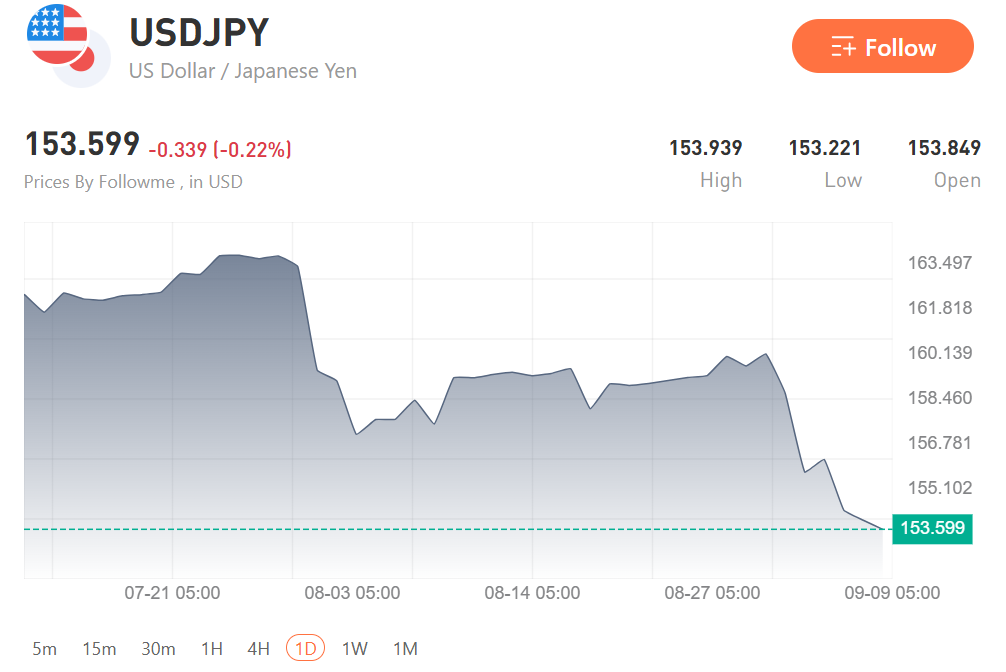
USD/JPY 153.59 as of Sep 9, 2026 - View Live Chart →
The Facts
- Wages: Nominal cash earnings +4.7% YoY in July (consensus 3.9%, prior 4.0%), fastest since January 1997. Base pay +4.1%, fastest since April 1992. Real wages +2.4%, seventh consecutive rise.
- GDP: Q2 revised to +1.4% annualised (from +1.1%, consensus 1.6%). Quarterly rate +0.4% (from +0.3%). Capex -0.9% (revised up from -1.2%). Private consumption flat.
- Current account: July surplus of ¥2.988 trillion versus ¥2.87 trillion consensus.
- BOJ pricing: Swaps imply a 98% probability of a 25bp hike to 1.25% at the September 17-18 meeting. Reuters sources say the Bank has little appetite for a larger 50bp move and prefers the standard pace, though it's reportedly considering hiking roughly once a quarter going forward given Middle East-driven import costs and a tight labour market.
- Factory sentiment: The Reuters Tankan manufacturers' index rose to +21 in September from +18, the best reading since December 2021, on an electronics sub-index that jumped to +39 from +24 on semiconductor and data-centre demand. Non-manufacturers edged up to +29 from +28.
- Money supply: BOJ preliminary data shows M2 growth easing slightly to +2.0% YoY in August from +2.1% in July.
- USD/JPY technicals: Hammer candle off 152.89 low. A daily close above 154.42 opens the door to 155.00 and then the 200-day SMA near 158.45. A break below 153.00 exposes the January yearly low at 152.10.
What It Means
The wage and GDP numbers gave the BOJ what it needed on the economics side, cover to keep tightening without the move looking like it risks recovery. The market had already priced that outcome before Tuesday, so the data confirmed the hike rather than adding to it. That's the reason the Yen's initial spike didn't hold.
The bigger question isn't the September hike itself, it's the pace after it. Reuters' reporting suggests some officials are weighing a move to roughly quarterly hikes rather than treating September as an isolated step. If that shows up in the post-meeting language, it changes the calculus for anyone positioned on Yen strength being a one-off event tied to a single meeting. If the bank hikes and then leans cautiously, pointing to the flat consumption figures, some of the recent Yen strength could unwind fast.
The Tankan reading matters here too. Manufacturer sentiment at a near five-year high, led by chip and data-centre demand, gives the BOJ a second justification for normalising policy that isn't tied to the wage print at all. A hiking case built on more than one data series tends to hold up better than one resting on a single print, however strong.
What Traders Should Watch
USD/JPY - 153.00 held through Tuesday's spike; a break re-exposes the January low near 152.10. A daily close above 154.42 confirms the hammer and opens the path to 155.00.
BOJ communication on September 18 - the hike is priced. Whether the bank signals a faster hiking cadence afterward is the part that isn't.
US CPI and Thursday's PPI - the Fed meets September 15-16, a day before the BOJ. A hot US print revives Fed hike odds and could offset some of the Yen's strength through the Dollar side of the pair.
Household consumption data - flat private consumption is the one weak spot in an otherwise strong run. A pickup removes the BOJ's main reason for caution at a faster pace.
Oil and Middle East headlines - rising import costs from the region are part of why the BOJ may want to move quicker. De-escalation reduces that pressure.
The Bottom Line Japan's data run this week did what it needed to, wages, growth and business sentiment all pointed the same way. The hike is no longer in question. The pace after it is, and that's what decides whether 153.00 holds or gives way further before the meeting even happens.
Follow us for daily market insights, analysis, and the tools you need to trade with confidence.
Want to stay ahead of major macro developments that move the market? 👉 Follow Followme and check out the Weekly Economic Calendar
September 9, 2026 | This report is for informational purposes only and does not constitute financial advice. © 2026 Followme News
Download Followme Application


Follow us on:


風險提示:本文所述僅代表作者個人觀點,不代表 Followme 的官方立場。Followme 不對內容的準確性、完整性或可靠性作出任何保證,對於基於該內容所採取的任何行為,不承擔任何責任,除非另有書面明確說明。

-THE END-